

Finding real focus at work often feels like a daily struggle for many Texas professionals living with ADHD. Balancing urgent tasks while striving for sharper mental clarity is a familiar challenge. As interest grows in natural options like potent Lion’s Mane extract, exploring cognitive support strategies becomes central to managing symptoms and unlocking more productive routines. This guide offers practical insight into proven approaches and real-world solutions for supporting attention and memory without relying solely on prescription medications.
Table of Contents
- Defining Cognitive Support And Its Purpose
- Key Types Of Cognitive Support Interventions
- How Cognitive Support Works For ADHD
- Real-World Applications In Daily Life
- Risks And Choosing Safe Natural Solutions
Key Takeaways
| Point | Details |
|---|---|
| Cognitive Support Enhances Mental Performance | Utilizing targeted strategies can optimize attention, memory, and decision-making abilities across different life stages. |
| Personalized Approaches are Essential | Effective cognitive support requires tailoring techniques to individual strengths and challenges for maximum benefit. |
| Integrative Strategies Yield Best Results | Combining various cognitive interventions, including behavioral therapy and lifestyle modifications, leads to more effective support. |
| Natural Solutions Must Be Approach with Caution | Evaluate the safety and efficacy of natural cognitive interventions, seeking professional guidance when necessary. |
Defining Cognitive Support and Its Purpose
Cognitive support represents a critical framework for enhancing mental performance across diverse life stages. Cognitive strategies aim to optimize brain function through targeted interventions that improve attention, memory, problem-solving, and decision-making capabilities.
At its core, cognitive support provides individuals with specialized tools and techniques designed to maximize mental potential. These approaches are not limited to addressing cognitive challenges but serve as proactive methods for maintaining peak mental performance. The goal is creating an environment where mental processes can operate with maximum efficiency and clarity.
Key components of cognitive support include:
- Targeted mental exercises
- Strategic learning techniques
- Environmental optimization strategies
- Nutritional interventions
- Stress management protocols
Neurological research reveals that cognitive support is universally applicable, benefiting everyone from students struggling with complex academic material to professionals navigating high-pressure work environments. Cognitive mechanisms interact closely with purpose and motivation, suggesting that effective support strategies can significantly enhance overall mental well-being.
Mental Performance Framework
The cognitive support framework operates on several fundamental principles:
- Personalized approach to mental optimization
- Holistic understanding of individual cognitive strengths
- Dynamic adaptation to changing mental demands
- Continuous learning and skill development
Cognitive support is not about fixing deficits, but about unlocking extraordinary mental potential.
Pro tip: Develop a daily cognitive routine that includes mindfulness, targeted mental exercises, and consistent learning to progressively enhance your mental capabilities.
Key Types of Cognitive Support Interventions
Cognitive support interventions offer a diverse range of strategies designed to address mental performance challenges, particularly for individuals with ADHD. Comprehensive intervention approaches encompass multiple treatment modalities targeting specific cognitive functions and overall mental well-being.
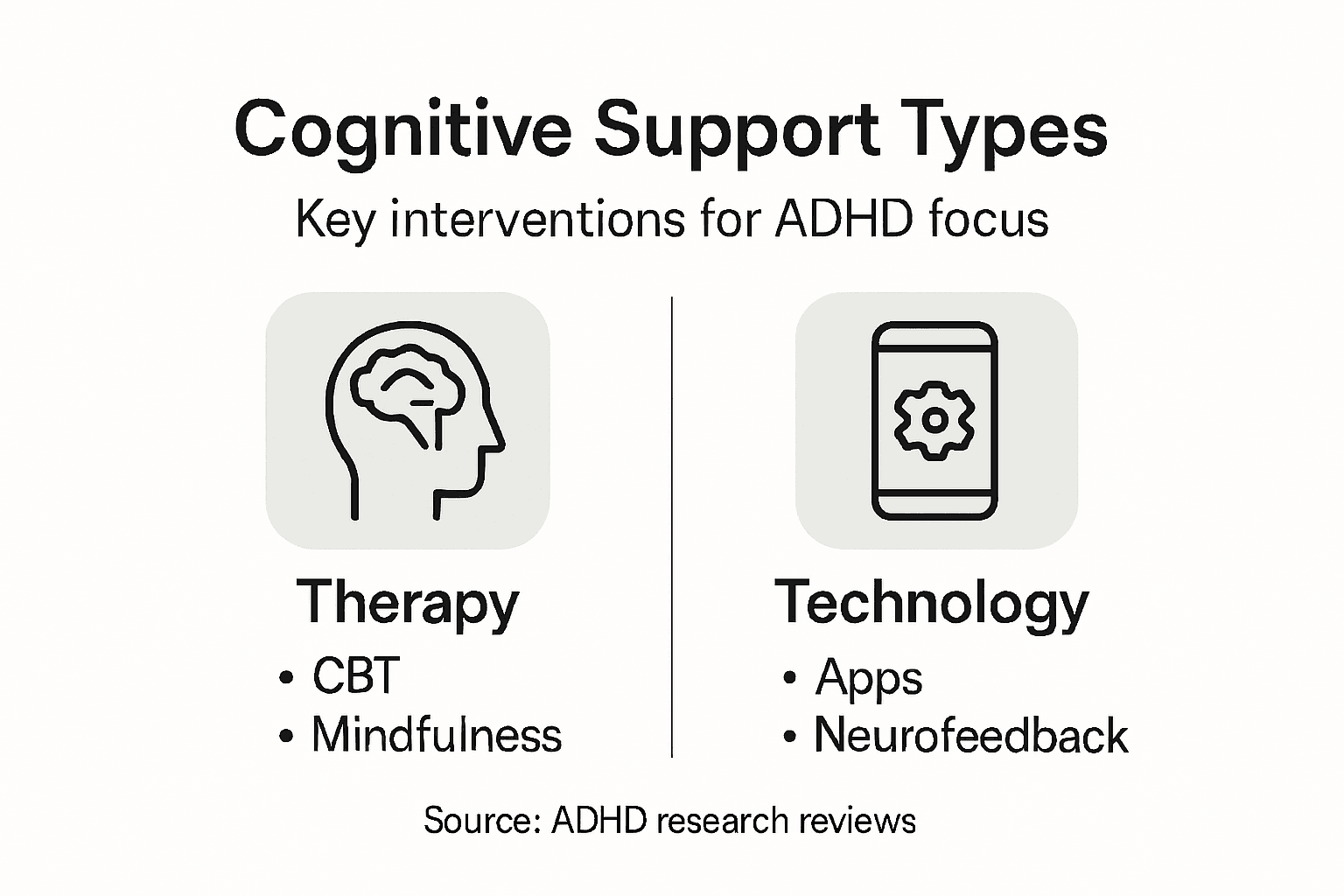
Behavioral Interventions represent a foundational approach to cognitive support. These strategies focus on developing practical skills, managing symptoms, and enhancing executive functioning. Techniques include structured routines, organizational strategies, and targeted skill-building exercises that help individuals develop more effective cognitive management techniques.
Key types of cognitive support interventions include:
- Non-stimulant medication management
- Behavioral therapy protocols
- Neurofeedback training
- Cognitive-behavioral therapy (CBT)
- Mindfulness-based interventions
- Brain stimulation techniques
Cognitive-behavioral therapy components have emerged as particularly effective, especially those integrating organizational strategies and problem-solving techniques. These interventions aim to mitigate core ADHD symptoms like inattention and impulsivity through targeted, adaptable approaches.
Here’s a summary highlighting how common cognitive support interventions differ in mechanism and ideal use cases:
| Intervention Type | Primary Mechanism | Best For |
|---|---|---|
| Behavioral Therapy | Structured routines, skill building | Daily management of symptoms |
| Neurofeedback Training | Brainwave modulation | Focus and attention challenges |
| Cognitive-Behavioral Therapy | Thought and behavior modification | Impulsivity, emotional control |
| Mindfulness-Based Interventions | Stress reduction, present awareness | Managing anxiety and reactivity |
| Non-Stimulant Medications | Neurotransmitter level adjustment | Those intolerant to stimulants |
Treatment Modality Breakdown
The most sophisticated cognitive support interventions typically combine multiple approaches:
- Personalized medication strategies
- Targeted psychological interventions
- Skill development programs
- Lifestyle and environmental modifications
Effective cognitive support is not about a single solution, but a holistic, integrated approach tailored to individual needs.
Pro tip: Consult with a neuropsychology professional to develop a personalized cognitive support strategy that addresses your specific mental performance goals and challenges.
How Cognitive Support Works for ADHD
ADHD cognitive support strategies fundamentally target executive dysfunction by retraining cognitive control mechanisms. These interventions are designed to address the core neurological challenges that individuals with ADHD experience, focusing on improving attention regulation, impulse management, and overall cognitive performance.

Neurocognitive Domains play a critical role in understanding how cognitive support works. ADHD impacts multiple mental processing areas, including inhibition, working memory, decision-making, and timing. By developing targeted interventions, professionals can help individuals develop more effective cognitive management strategies.
Key mechanisms of cognitive support for ADHD include:
- Enhancing neural network connectivity
- Improving executive function skills
- Developing adaptive coping strategies
- Strengthening attentional control
- Modulating neurotransmitter responses
Neurocognitive treatment approaches combine both pharmacological and non-pharmacological interventions to address ADHD’s complex neurological landscape. These methods aim to modulate brain function, helping individuals develop more robust cognitive control and adaptive responses to environmental challenges.
Intervention Strategy Breakdown
Effective cognitive support for ADHD typically involves a multi-dimensional approach:
- Comprehensive neuropsychological assessment
- Personalized intervention planning
- Targeted skill development
- Ongoing progress monitoring
Cognitive support is not about changing who you are, but about empowering your brain to work more effectively.
Pro tip: Integrate multiple cognitive support strategies and remain patient with yourself, as developing new mental skills is a gradual process that requires consistent practice and self-compassion.
Real-World Applications in Daily Life
Mixed reality technologies are revolutionizing cognitive support for professionals with ADHD, offering innovative solutions that address real-world communication and attention challenges. These advanced tools provide context-aware assistance, helping individuals navigate complex social and professional interactions with greater confidence and precision.
Practical Intervention Strategies translate cognitive support from theoretical concepts into actionable daily practices. Professionals with ADHD can leverage targeted techniques that minimize cognitive load and maximize mental performance across various life domains, from workplace productivity to personal relationship management.
Key real-world cognitive support applications include:
- Communication assistance technologies
- Digital cognitive training platforms
- Context-aware mobile applications
- Adaptive workflow management tools
- Personalized reminder and organization systems
Digital cognitive training programs demonstrate remarkable potential in providing continuous, accessible cognitive enhancement. These remote interventions offer flexible solutions that adapt to individual needs, making cognitive support more convenient and personalized than traditional therapeutic approaches.
Technology-Enhanced Support Techniques
Effective real-world cognitive support integrates multiple strategies:
- Technology-assisted attention management
- Personalized skill development
- Adaptive learning environments
- Real-time cognitive performance tracking
Cognitive support is about transforming challenges into opportunities through intelligent, personalized interventions.
Pro tip: Experiment with multiple digital cognitive support tools and track your progress to discover the most effective strategies for your unique cognitive profile.
Risks and Choosing Safe Natural Solutions
Natural environment interventions offer promising low-risk cognitive support strategies for professionals managing ADHD symptoms. Understanding the nuanced landscape of natural solutions requires careful evaluation of potential benefits, safety profiles, and individual physiological responses.
Safety Considerations are paramount when exploring alternative cognitive support approaches. While natural interventions can provide valuable support, professionals must approach these solutions with informed caution, recognizing that not all supplements or strategies work identically for every individual with ADHD.
Key risk mitigation strategies for natural cognitive support include:
- Comprehensive medical consultation
- Thorough research of supplement ingredients
- Understanding potential interactions
- Regular monitoring of cognitive and physiological responses
- Maintaining transparent communication with healthcare providers
Complementary health approaches demonstrate mixed but intriguing evidence for managing ADHD symptoms. These interventions, such as omega-3 supplementation, require rigorous personal investigation and professional guidance to ensure safe and effective implementation.
Below is a comparison of digital versus natural cognitive support strategies for ADHD professionals:
| Approach Type | Accessibility | Risk Level | Example Solution |
|---|---|---|---|
| Digital/Technological | Anytime, remote access | Low (with guidance) | Digital cognitive training app |
| Natural/Complementary | Varies, often outdoors | Moderate, individualized | Omega-3 supplementation |
Natural Solution Selection Framework
Effective natural cognitive support demands a strategic approach:
- Consult with healthcare professionals
- Conduct comprehensive personal health assessment
- Start with low-risk, well-researched interventions
- Monitor and document individual responses
Natural solutions are not magic bullets, but potential tools in a comprehensive cognitive support strategy.
Pro tip: Keep a detailed journal tracking your cognitive performance, supplement intake, and potential side effects to develop a personalized, evidence-based approach to natural cognitive support.
Unlock Enhanced Focus with Natural Cognitive Support
The article highlights the ongoing challenge of managing ADHD symptoms like inattention and impulsivity through cognitive support strategies. If you are seeking effective, natural solutions to promote executive function and attentional control, incorporating clinically potent supplements can be a game changer. Concepts such as personalized intervention planning and daily mental performance routines align perfectly with natural nootropics designed to enhance brain connectivity and cognitive resilience.
Experience the power of Cortex Flow, our premium Lions Mane extract capsule, derived from 100% American-grown fruiting bodies harvested and freeze-dried to maintain maximal potency. Our uniquely extracted 36 to 1 formula supports neuroplasticity and executive function, making it an ideal complement to behavioral and mindfulness-based interventions for ADHD. Learn more about our complete approach to natural cognitive enhancement on the Cortex Supplements homepage or explore how targeted mental exercises can harmonize with plant-based cognitive support.
Take control of your mental focus today with a supplement trusted by professionals seeking to unlock extraordinary brain performance.

Discover why so many choose Cortex Flow for their cognitive support routine. Visit Cortex Supplements now to start elevating your focus and brain health with a natural, scientifically crafted solution designed specifically for minds with ADHD.
Frequently Asked Questions
What is cognitive support and how does it benefit individuals with ADHD?
Cognitive support involves using targeted strategies and interventions to enhance mental performance. For individuals with ADHD, these strategies can help improve focus, attention regulation, and overall cognitive management, leading to better daily functioning.
What are some effective cognitive support interventions for managing ADHD symptoms?
Effective interventions include behavioral therapy, cognitive-behavioral therapy (CBT), neurofeedback training, and mindfulness-based strategies. These approaches address various cognitive challenges and enhance executive functioning skills.
How do technology-assisted cognitive support tools work for ADHD?
Technology-assisted tools, like digital cognitive training platforms and context-aware mobile applications, provide real-time assistance to manage attention and enhance productivity, adapting to the user’s unique cognitive needs and challenges.
What safety considerations should be taken into account when using natural cognitive support strategies?
When using natural interventions, it is crucial to consult healthcare professionals, research supplement ingredients, and monitor individual responses for potential interactions or side effects to ensure safe and effective use.
Recommended
- Supplements for Professionals: Enhancing Focus and Clarity – Cortex Supplements
- Lions Mane Supplement Guide for Enhanced Focus and Clarity – Cortex Supplements
- 6 Types of Lion’s Mane Extracts for Enhanced Focus – Cortex Supplements
- Lion’s Mane Supplement Workflow for Enhanced Focus – Cortex Supplements
