

Afternoon brain fog can drain productivity for even the most determined Austin professionals with ADHD. When standard treatments fall short or side effects become too much, the search for a reliable natural solution feels urgent. Lion’s Mane stands out for its bioactive compounds that cross the blood-brain barrier to stimulate nerve growth factor (NGF) production, supporting brain health and cognitive function without harsh stimulant effects.
Table of Contents
- What Is Lion’s Mane and How It Works
- ADHD Symptoms and Standard Treatment Options
- Lion’s Mane Cognitive Benefits for ADHD
- Safety, Side Effects, and Usage Recommendations
- Comparing Lion’s Mane With Other Natural Solutions
Key Takeaways
| Point | Details |
|---|---|
| Lion’s Mane Enhances Cognitive Function | The bioactive compounds in Lion’s Mane stimulate nerve growth factor production, promoting neural growth and enhancing cognitive performance, particularly for those with ADHD. |
| Consistency Is Key for Optimal Benefits | To achieve the best results, take Lion’s Mane daily over several weeks, rather than relying on it for immediate focus enhancement. |
| Supplement, Don’t Substitute | Lion’s Mane should complement existing ADHD treatments, focusing on underlying neural health rather than replacing medications or behavioral therapy. |
| Gradual Improvement in Focus and Memory | Users can expect gradual improvements in focus duration, mental clarity, and overall cognitive function as Lion’s Mane supports structural brain changes. |
What Is Lion’s Mane and How It Works
Lion’s Mane isn’t your typical mushroom—it’s an edible fungus with real neuroscience backing it. This white, shaggy mushroom (Hericium erinaceus) has been used in traditional medicine for centuries, but modern research is now proving why professionals in Austin are turning to it for focus support.
The magic happens at the molecular level. Lion’s Mane contains specific bioactive compounds called hericenones and erinacines that do something remarkable: they cross the blood-brain barrier and stimulate nerve growth factor (NGF) production. Think of NGF as your brain’s repair and growth signal—it tells your neurons to strengthen connections and regenerate.
When you’re struggling with afternoon brain fog or ADHD-related focus issues, this matters. Your brain needs that NGF signal to maintain sharp cognitive function and build new neural pathways. Bioactive compounds in Lion’s Mane support this process naturally.
The Complete Chemical Profile
Lion’s Mane works through multiple mechanisms, not just one.
- Hericenones and erinacines: Stimulate NGF and promote neuron growth
- Polysaccharides: Support immune function and provide antioxidant protection
- Peptides: Build the structural components your brain needs
- Antioxidants: Fight oxidative stress that damages cognitive performance
This combination means Lion’s Mane doesn’t just help you focus—it protects your brain while doing it. The antioxidant and anti-inflammatory effects address the underlying causes of brain fog, not just the symptoms.
Lion’s Mane crosses the blood-brain barrier, meaning its active compounds actually reach your brain tissue where they’re needed most.
How It Supports ADHD Focus
For professionals with ADHD, the problem isn’t laziness—it’s neurotransmitter regulation and neural connectivity. Your brain struggles to maintain attention because the signals between neurons aren’t firing efficiently.
Lion’s Mane addresses this by promoting neurogenesis—the growth of new brain cells—and strengthening existing neural connections. When neurons communicate better, your ability to focus and sustain attention improves. You’re not forcing focus through stimulation; you’re building your brain’s natural capacity.
This is why timing matters. Lion’s Mane works best as a foundational support taken consistently, not as an on-demand focus boost. Your brain needs time to build those new connections and strengthen existing pathways.
The approach Texas-based Cortex Supplements takes reflects this reality: their freeze-dried 36:1 ratio extract from 100% Lion’s Mane fruiting bodies delivers maximum potency. This concentration means you get the active compounds your brain needs without unnecessary fillers.
Pro tip: Start taking Lion’s Mane at the same time each morning with a light meal containing healthy fats—this helps your body absorb the bioactive compounds more effectively.
ADHD Symptoms and Standard Treatment Options
If you’ve been diagnosed with ADHD as an adult, you’re not alone. The condition doesn’t disappear after childhood—it adapts and persists, creating real challenges at work, home, and in relationships. Understanding what’s actually happening in your brain helps you make informed choices about treatment.
ADHD shows up as three primary symptom clusters: inattention, hyperactivity, and impulsivity. For professionals in Austin, inattention is often the biggest workplace problem—you start a task, your mind drifts, and suddenly an hour has passed. Hyperactivity might look less obvious than fidgeting; it’s mental restlessness and racing thoughts. Impulsivity means interrupting meetings, making snap decisions you regret, or struggling to wait your turn.
These aren’t character flaws or laziness. ADHD symptoms cause functional impairment across multiple life areas, and the impact compounds over time without proper management.
How Standard Treatment Works
The gold standard for ADHD treatment combines multiple approaches, not just medication.
- Stimulant medications (like methylphenidate): Increase dopamine and norepinephrine, improving focus and impulse control
- Non-stimulant medications (like atomoxetine): Work differently but address similar neurotransmitter issues
- Behavioral therapy: Builds organizational systems and coping strategies
- Coaching and workplace accommodations: Reduces environmental friction
Pharmacotherapy remains the most researched and proven approach. Medications help your brain’s executive function systems work closer to baseline, meaning you can actually apply your skills and intelligence.
Standard ADHD treatment works best as a combination strategy—medication addresses brain chemistry, while behavioral approaches address habits and systems.
The Real Limitations
Here’s what the research reveals: medication works for many people, but it’s not perfect. Some professionals experience side effects like appetite suppression, sleep disruption, or emotional blunting. Others find their current dose stops working as effectively over time.
Personalized dosing remains a significant gap. Your neurochemistry is unique, and finding the right medication and dosage often involves trial and error. Some people need augmentation strategies—adding complementary support to boost results without increasing medication doses.
This is where the conversation shifts to natural support options. Cognitive support strategies like Lion’s Mane aren’t meant to replace medication, but they can work alongside it to address the underlying neurobiology of attention and focus.
Many professionals working in high-pressure Austin tech and business environments benefit from a layered approach: medication for immediate brain chemistry support, behavioral strategies for systems and habits, and natural supplements like Lion’s Mane for long-term neural health and regeneration.
Pro tip: Track your ADHD symptoms and medication effects in a simple spreadsheet for two weeks before adding any supplement—this baseline helps you notice what actually works for your brain.
Lion’s Mane Cognitive Benefits for ADHD
Lion’s Mane addresses something fundamental that ADHD brains struggle with: neural connectivity and sustained attention capacity. But here’s the honest part—the research on Lion’s Mane specifically for ADHD is still emerging.

The science shows promise in related areas. Cognitive processing speed improvements have appeared in studies with healthy adults taking Lion’s Mane, along with reduced subjective stress. For someone with ADHD, processing speed directly affects your ability to organize thoughts, respond to meetings, and shift between tasks without losing the thread.
What Lion’s Mane does uniquely is address the neural foundation beneath ADHD symptoms. It stimulates nerve growth factor (NGF) production, which promotes neurogenesis—literally growing new brain cells. Your ADHD brain doesn’t need more stimulation; it needs better-functioning neural networks. That’s where Lion’s Mane operates.
How This Translates to Real ADHD Benefits
Your ADHD brain struggles with executive function because neurons aren’t communicating efficiently. Lion’s Mane strengthens these connections over time.
- Improved focus duration: Better neural networks mean your attention can stay locked in longer
- Reduced mental fatigue: Less compensatory effort needed to concentrate
- Enhanced working memory: Better neuron firing patterns support holding information in mind
- Clearer thinking: Anti-inflammatory effects reduce the brain fog that masks ADHD
- Mood stability: Cognitive improvements often naturally reduce frustration and anxiety
These aren’t quick fixes. Lion’s Mane works over weeks and months as your brain literally builds new neural tissue and strengthens existing pathways. This is why consistency matters more than dosage.
While large-scale ADHD trials are limited, the mechanisms by which Lion’s Mane works—neural regeneration and inflammation reduction—directly address core ADHD neurobiology.
The Realistic Expectation
Lion’s Mane works best as a foundation-builder, not a replacement for ADHD medication. Think of it this way: medication handles your neurotransmitter chemistry today. Lion’s Mane builds your brain’s structural capacity over time.
Many Austin professionals benefit from using Lion’s Mane alongside their current treatment plan. You’re not changing what works; you’re adding a complementary strategy that addresses the neurological underpinnings of attention and focus.
The high-potency Lion’s Mane supplement approach with Cortex’s 36:1 extract delivers maximum active compounds without filler, making consistency practical and affordable.
Pro tip: Give Lion’s Mane at least 4-6 weeks before evaluating its effects—your brain needs time to build new neural connections, so patience yields better results than expecting immediate focus improvements.
The following summary outlines how Lion’s Mane and standard ADHD treatments support cognitive function differently:
| Approach | Immediate Effect | Impact on Brain Structure | Ideal Use Case |
|---|---|---|---|
| Stimulant Medication | Rapid (within hours) | Adjusts neurotransmitter signaling | Acute symptom management |
| Non-stimulant Medication | Gradual (days-weeks) | Balances norepinephrine, minor structure impact | Alternative to stimulants |
| Behavioral Therapy | Long-term (weeks+) | Builds organizational skills | System and habit building |
| Lion’s Mane Supplement | Slow (weeks-months) | Stimulates neural regeneration | Foundational neuro-support |
Safety, Side Effects, and Usage Recommendations
Lion’s Mane has an excellent safety profile. Clinical research shows it’s well-tolerated across a wide range of doses, making it accessible for most professionals looking to support their ADHD management without major concerns.
The most commonly reported side effects are mild and gastrointestinal in nature. Some people experience slight stomach discomfort, nausea, or digestive changes when first starting Lion’s Mane. These typically resolve within a few days as your body adjusts. They’re rarely severe enough to stop taking the supplement.
Lion’s Mane doses in clinical studies range from 1050 to 3000 mg daily, usually split into divided doses throughout the day. Most people see benefits starting at 1-2 grams daily. Higher doses don’t necessarily mean better results—consistency and quality matter far more than pushing dosage up.
Who Should Exercise Caution
Lion’s Mane is safe for most people, but certain conditions require medical consultation first.
- Autoimmune disorders: Lion’s Mane may modulate immune function; discuss with your doctor before starting
- Blood clotting conditions or medications: Possible interactions with anticoagulants; professional guidance needed
- Diabetes medications: May affect blood sugar regulation; monitor closely with your healthcare provider
- Pregnancy or breastfeeding: Insufficient safety data; avoid until more research exists
- Scheduled surgery: Stop taking Lion’s Mane 2 weeks before procedures due to possible bleeding effects
If you take ADHD medications, Lion’s Mane doesn’t interact with stimulants or non-stimulant medications. You’re simply adding a complementary support strategy.
Lion’s Mane shows no serious adverse effects at typical doses, making it one of the safer cognitive supplements available when taken as directed.
How to Start Safely
Begin with a conservative dose and observe how your body responds. This approach lets you notice any individual sensitivities before committing to a higher dose.
Start with 500-750 mg daily for your first week, taken with a meal to minimize stomach upset. After 7-10 days, increase to your target dose of 1-2 grams daily. Quality matters—ensure your supplement uses standardized extract from fruiting bodies, not mycelium on grain.
Cortex’s 36:1 freeze-dried extract means every capsule delivers concentrated active compounds. You’re getting genuine potency without the filler that cheaper brands use.
Track how you feel over 4-6 weeks. Notice changes in focus duration, mental clarity, and energy levels. Keep expectations realistic—you’re building neural capacity, not seeking an immediate stimulant effect.
Pro tip: Take Lion’s Mane with a source of healthy fat (like olive oil or avocado) since its active compounds are fat-soluble and absorb better in your digestive system.
Comparing Lion’s Mane With Other Natural Solutions
You’ve probably seen other natural supplements marketed for ADHD focus—ginkgo biloba, ashwagandha, bacopa, omega-3s. They all work, but they work differently. Understanding how Lion’s Mane differs helps you make a choice aligned with your actual needs.
Most natural cognitive supplements fall into two categories: neurotransmitter modulators and neuroprotectors. Ginkgo and bacopa improve blood flow and support existing neurotransmitter function. Ashwagandha reduces stress and anxiety, indirectly supporting focus. These are valuable, but they’re not building new brain cells.
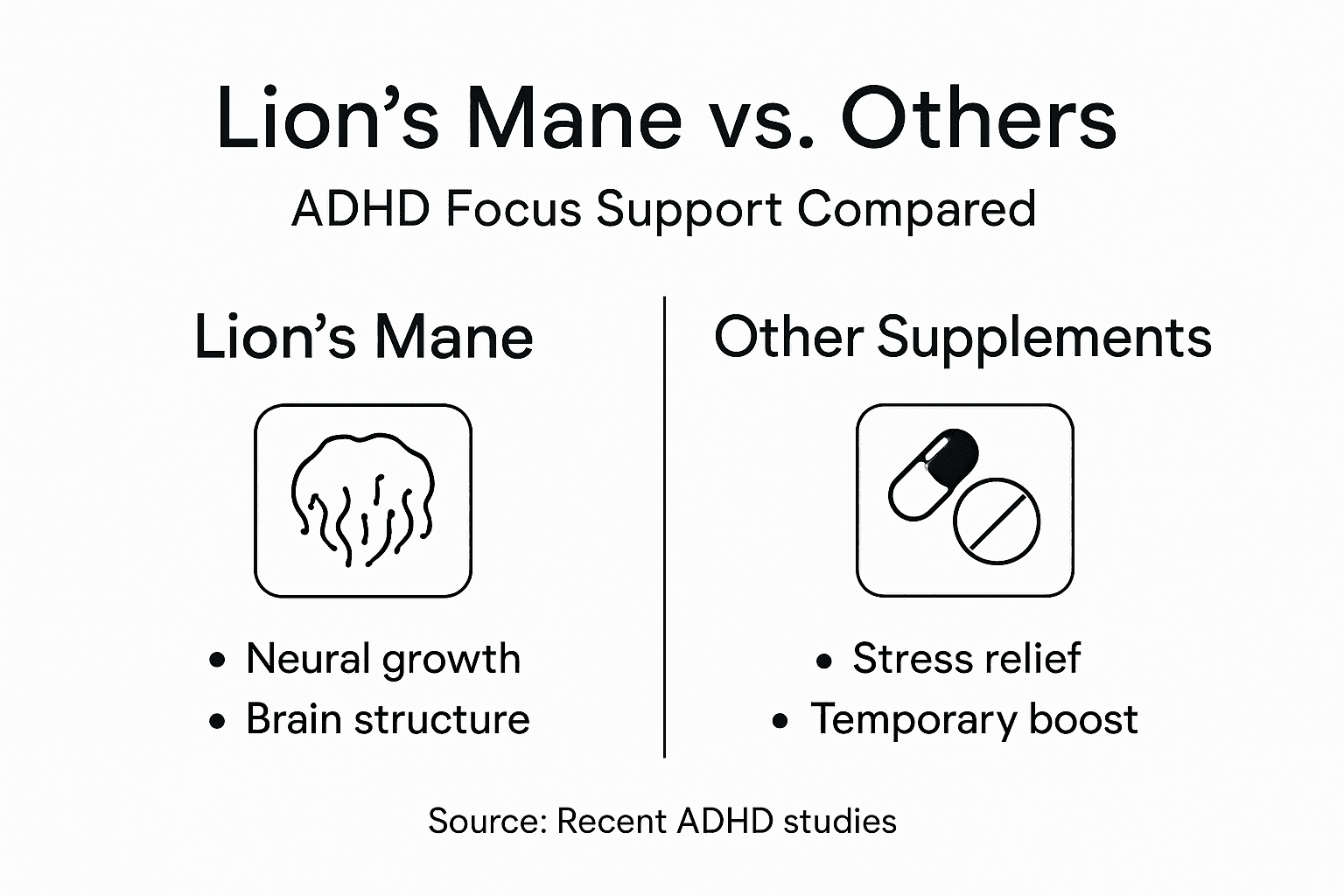
Lion’s Mane operates in a completely different category. Lion’s Mane stimulates nerve growth factor, which actually promotes neurogenesis—the growth of new neurons. You’re not just optimizing what exists; you’re expanding your brain’s capacity.
Head-to-Head Comparison
Here’s how Lion’s Mane stacks against common alternatives:
- Ginkgo biloba: Improves blood flow, modest focus benefits; works quickly but plateaus
- Ashwagandha: Reduces stress and anxiety; helps focus indirectly through relaxation
- Bacopa: Supports memory and processing speed; gentler than stimulants but slower acting
- Caffeine: Immediate stimulation; creates dependency and crashes; doesn’t build neural capacity
- L-theanine: Calms without sedation; pairs well with caffeine but doesn’t support neural growth
- Lion’s Mane: Builds neural connections; works gradually; addresses root ADHD neurobiology
The key difference: others mask ADHD symptoms or provide temporary focus boosts. Lion’s Mane addresses the underlying neural architecture that causes ADHD focus struggles.
Here’s a quick reference comparing how popular natural supplements for ADHD differ in their core mechanisms:
| Supplement | Primary Action | Expected Time to Results | Unique Long-Term Benefit |
|---|---|---|---|
| Lion’s Mane | Stimulates neural growth | 4-6 weeks or longer | Promotes new neuron connections |
| Ginkgo Biloba | Enhances brain blood flow | 1-2 weeks | May support circulation and alertness |
| Ashwagandha | Reduces stress hormone levels | 2-4 weeks | Supports resilience to anxiety |
| Bacopa Monnieri | Supports neurotransmitter activity | 4-6 weeks | Strengthens memory formation |
| Omega-3s | Improves membrane fluidity | 6+ weeks | Supports brain cell structure |
Lion’s Mane’s neurotrophic activity supports long-term brain health, unlike stimulants or adaptogens that provide short-term symptom relief.
Can You Combine Them?
Absolutely. Lion’s Mane works well alongside other natural supplements. In fact, many professionals layer them strategically.
You might use ashwagandha for immediate stress management during intense work periods, while Lion’s Mane builds your foundational neural capacity over months. Bacopa supports memory; Lion’s Mane supports focus. They address different cognitive needs.
The advantage of Lion’s Mane specifically for ADHD is its focus on structural brain changes rather than temporary neurotransmitter tweaks. Natural supplements for attention work best when matched to what you’re actually trying to achieve.
Don’t chase the supplement that gives you the biggest immediate buzz. Choose the one that builds what your brain actually needs. For ADHD focus, that’s neural regeneration and connection strength.
Pro tip: Take Lion’s Mane consistently for 4-6 weeks before adding other focus supplements—this lets you isolate Lion’s Mane’s effects and understand your baseline cognitive response.
Unlock Your Brain’s Potential with the Most Potent Lion’s Mane Extract
Struggling with ADHD focus and the frustration of inconsistent attention can feel overwhelming. The challenges of supporting your brain’s natural ability to build stronger neural connections call for a solution rooted in science—not just quick fixes. Cortex Flow is designed specifically to address this need. Our freeze-dried 36 to 1 ratio Lion’s Mane extract harnesses the power of 100% fruiting bodies grown in the United States, offering maximum potency to support nerve growth factor production and long-term cognitive resilience.

Experience why professionals in Texas trust Cortex for foundational brain support. Take control today by visiting our website to learn how Cortex Flow can complement your ADHD management plan. Don’t settle for less when it comes to your focus and mental clarity. Start building your brain’s natural capacity now with the world’s most potent Lion’s Mane supplement.
Frequently Asked Questions
What is Lion’s Mane, and how does it support ADHD focus?
Lion’s Mane is an edible mushroom that contains bioactive compounds called hericenones and erinacines. These compounds stimulate nerve growth factor (NGF) production, which promotes the growth of new neurons and strengthens existing neural connections, helping improve focus and attention in individuals with ADHD.
How long does it take to see the cognitive benefits of Lion’s Mane for ADHD?
The cognitive benefits of Lion’s Mane typically take 4-6 weeks to develop. Consistent daily use allows the compounds to build neural connections, contributing to improved focus and cognitive function over time.
Can Lion’s Mane be used alongside ADHD medications?
Yes, Lion’s Mane can be safely used alongside ADHD medications. It acts as a complementary support strategy, addressing the underlying neurobiology of attention and focus without interfering with the medications’ effects.
Are there any side effects associated with taking Lion’s Mane?
Lion’s Mane has an excellent safety profile, with the most commonly reported side effects being mild gastrointestinal discomfort. These typically resolve within a few days as your body adjusts. Always consult a healthcare professional if you have specific medical conditions before starting any supplement.
