

Most natural supplements claim to support brain health, but Lion’s Mane mushroom stands apart because it actually stimulates nerve growth factor, a protein essential for neuron survival and growth. Unlike vague promises of mental clarity, Lion’s Mane delivers measurable cognitive improvements backed by clinical trials. If you’re seeking a natural way to enhance memory, protect against cognitive decline, and support long-term brain health, understanding how this mushroom works can transform your approach to mental wellness. This article breaks down the science, benefits, and practical steps to harness Lion’s Mane for optimal cognitive function.
Table of Contents
- What Makes Lion’s Mane Mushrooms Unique For Brain Health
- Science-Backed Benefits For Cognition And Neuroprotection
- How To Incorporate Lion’s Mane Mushrooms For Brain Health
- Potential Risks And Expert Insights On Long-Term Use
- Explore Brain-Boosting Lion’s Mane Supplements
- Frequently Asked Questions
Key takeaways
| Point | Details |
|---|---|
| Unique nerve growth stimulation | Lion’s Mane contains compounds that cross the blood-brain barrier and promote neuron repair and growth. |
| Proven cognitive improvements | Clinical trials show enhanced memory, learning speed, and reduced stress with consistent supplementation. |
| Neuroprotective properties | Anti-inflammatory and antioxidant effects protect brain cells from damage and age-related decline. |
| Safe traditional use | Classified as a superior herb in Traditional Chinese Medicine, suitable for daily consumption. |
| Optimal dosing matters | Effective doses range from 1.8 to 3.2 grams daily depending on your cognitive health goals. |
What makes Lion’s Mane mushrooms unique for brain health
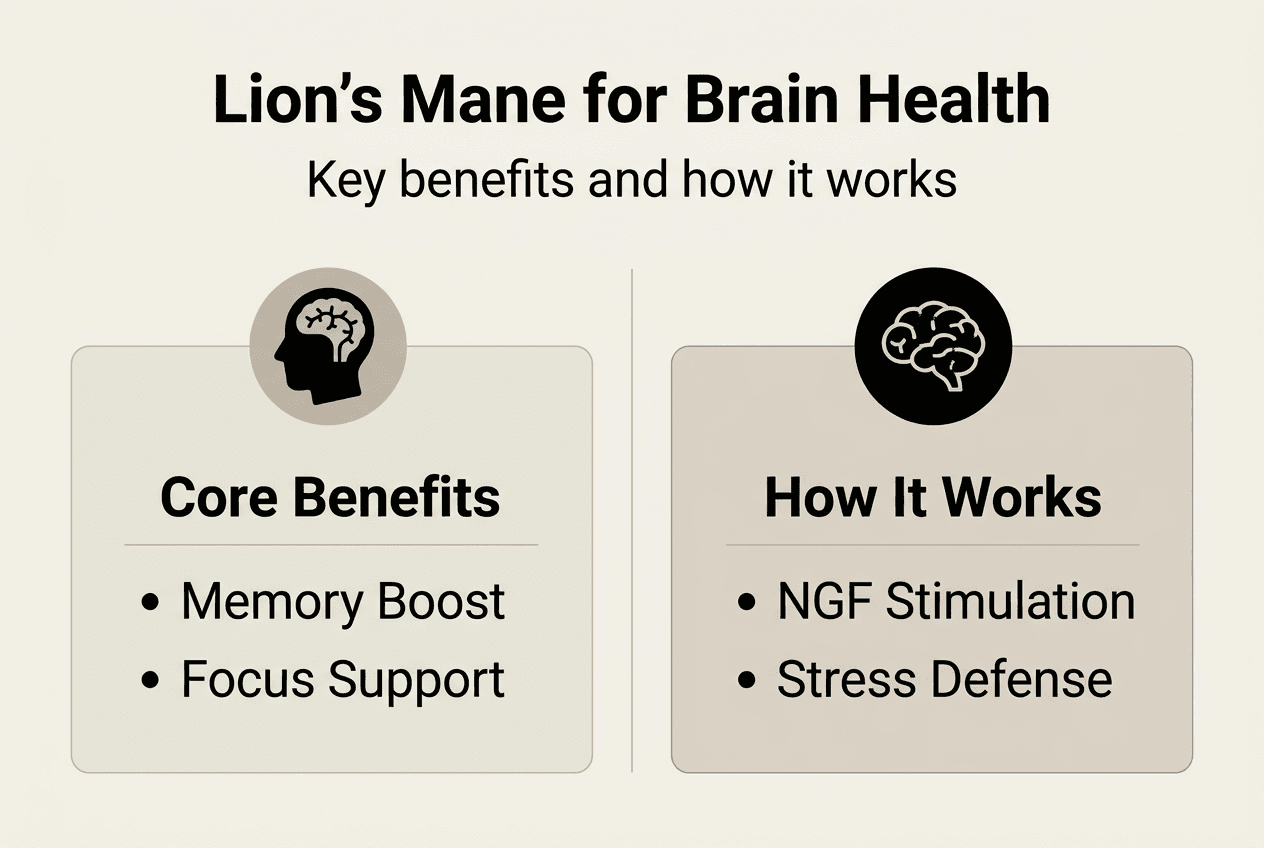
Lion’s Mane mushroom earns its reputation through two rare bioactive compounds: hericenones and erinacines. These molecules do something most natural supplements cannot: they cross the blood-brain barrier and directly influence brain chemistry. Once inside, they stimulate nerve growth factor production, a protein critical for maintaining, organizing, and regenerating neurons.
Nerve growth factor plays a pivotal role in areas of the brain responsible for memory and learning, particularly the hippocampus. Without adequate NGF, neurons struggle to form new connections, repair damage, or maintain optimal function. As we age, NGF levels naturally decline, contributing to memory lapses and slower cognitive processing. Lion’s Mane counteracts this decline by providing the biochemical support neurons need to thrive.
Beyond NGF stimulation, Lion’s Mane addresses inflammation and oxidative stress, two silent threats to brain health. Chronic inflammation damages neural tissue and accelerates cognitive decline. The mushroom’s compounds modulate inflammatory pathways, reducing harmful immune responses while preserving protective mechanisms. This dual action makes Lion’s Mane particularly valuable for preventing conditions like Alzheimer’s disease, where beta-amyloid plaques trigger destructive inflammation.
Traditional Chinese Medicine recognized Lion’s Mane centuries ago, classifying it as a superior herb safe for daily use. Practitioners prescribed it to strengthen the spleen, nourish the gut, and support mental clarity. Modern science validates these traditional applications, revealing mechanisms that ancient healers could only observe through patient outcomes.
The mushroom’s benefits extend to myelin production, the protective sheath surrounding nerve fibers. Healthy myelin ensures fast, efficient signal transmission between neurons. Damage to myelin, as seen in multiple sclerosis, severely impairs cognitive and motor function. Lion’s Mane supports myelin repair and maintenance, contributing to overall neurological resilience.
Key bioactive benefits include:
- Hericenones found primarily in the fruiting body enhance NGF synthesis in brain tissue.
- Erinacines concentrated in the mycelium penetrate the blood-brain barrier more effectively.
- Antioxidant properties neutralize free radicals that damage cellular structures.
- Anti-inflammatory action reduces chronic neuroinflammation linked to cognitive decline.
“Lion’s Mane represents one of the few natural compounds with direct neuroprotective and regenerative properties, making it a cornerstone of integrative brain health strategies.”
Pro Tip: Look for supplements containing both fruiting bodies and mycelium to access the full spectrum of hericenones and erinacines for comprehensive brain support.
Science-backed benefits for cognition and neuroprotection
Clinical research consistently demonstrates Lion’s Mane’s ability to improve cognitive performance across diverse populations. A 2025 meta-analysis of randomized controlled trials found that participants taking Lion’s Mane showed a combined MMSE score increase of 1.17 compared to placebo groups. This improvement, while seemingly modest, represents meaningful progress in memory, attention, and executive function, especially for older adults experiencing mild cognitive impairment.
More striking results emerged in studies measuring acute cognitive effects. Researchers documented a 6.7% improvement in processing speed within 60 minutes of a single 1.8-gram dose. Participants also reported an 18.7% reduction in subjective stress, suggesting Lion’s Mane influences both cognitive performance and emotional regulation. These rapid effects make it valuable for situations demanding peak mental performance.
Animal studies provide additional insights into mechanisms behind these benefits. Mice with induced memory deficits showed significant improvements in spatial learning and recognition tasks after Lion’s Mane supplementation. Brain tissue analysis revealed increased hippocampal neuron density and enhanced synaptic plasticity, the biological foundation of learning and memory. These findings suggest Lion’s Mane doesn’t just mask cognitive symptoms but actively repairs and strengthens neural networks.
Neuroprotection extends beyond immediate cognitive gains. Lion’s Mane reduces oxidative stress markers in brain tissue, protecting neurons from damage caused by metabolic waste and environmental toxins. This antioxidant activity proves particularly important in aging brains, where accumulated oxidative damage contributes to neurodegenerative diseases. By neutralizing reactive oxygen species before they harm cellular structures, Lion’s Mane preserves cognitive function over the long term.

The mushroom’s anti-inflammatory properties target specific pathways involved in neurodegeneration. Studies show reduced levels of pro-inflammatory cytokines in brain tissue following Lion’s Mane treatment. This inflammation reduction appears especially relevant for preventing beta-amyloid plaque formation, a hallmark of Alzheimer’s disease. While not a cure, these protective effects may slow disease progression when combined with other interventions.
Cognitive improvements documented in trials:
- Enhanced verbal and visual memory in healthy adults after 8 weeks of supplementation.
- Improved attention span and reduced mental fatigue during demanding cognitive tasks.
- Better executive function, including planning, problem-solving, and flexible thinking.
- Reduced anxiety symptoms, likely through modulation of neurotransmitter systems.
| Study Type | Duration | Dosage | Primary Outcome |
|---|---|---|---|
| Acute cognitive trial | Single dose | 1.8g | 6.7% faster processing speed |
| Chronic supplementation | 8 weeks | 3.0g daily | MMSE score increase of 1.17 points |
| Neuroprotection study | 12 weeks | 3.2g daily | Reduced oxidative stress markers |
| Anxiety reduction trial | 4 weeks | 2.0g daily | 18.7% decrease in stress scores |
Pro Tip: Consistency matters more than dosage for chronic benefits. Taking a moderate dose daily for several weeks produces more reliable cognitive improvements than sporadic high doses. For guidance on choosing quality supplements, prioritize products with verified potency and bioactive compound content.
How to incorporate Lion’s Mane mushrooms for brain health
Selecting the right Lion’s Mane supplement requires understanding product forms and their bioactive profiles. Fruiting body extracts contain high concentrations of hericenones, while mycelium-based products deliver more erinacines. Ideally, choose supplements combining both components to access the complete range of neuroprotective compounds. Extraction ratio matters too. A 36:1 extract concentrates bioactives far more effectively than whole mushroom powder, ensuring you receive therapeutic doses in manageable capsule sizes.
Dosage varies based on your cognitive health goals. For acute cognitive enhancement before mentally demanding tasks, 1.8 grams provides measurable benefits within an hour. For long-term neuroprotection and chronic cognitive support, studies suggest 3.2 grams daily yields optimal results. Start at the lower end of this range to assess tolerance, then gradually increase if needed. Dividing doses between morning and afternoon maintains steady bioactive levels throughout the day.
Consistency determines success with Lion’s Mane supplementation. Unlike stimulants that produce immediate effects, the mushroom’s neuroprotective benefits accumulate over weeks. Most clinical trials showing significant cognitive improvements ran for at least four weeks, with some extending to 16 weeks. Expect subtle changes initially, such as improved focus or reduced mental fatigue, before noticing more substantial memory and learning enhancements.
Product quality varies dramatically across brands. Look for supplements using fruiting bodies rather than mycelium grown on grain, as grain-based products often contain more filler than active mushroom compounds. Third-party testing for heavy metals, pesticides, and beta-glucan content provides additional quality assurance. Reputable manufacturers disclose extraction methods, compound concentrations, and sourcing practices transparently.
Integrating Lion’s Mane into your routine works best with consistent timing. Taking capsules with meals improves absorption and reduces potential stomach discomfort. Some users prefer morning doses to support daytime cognitive demands, while others split servings to maintain steady effects. Experiment with timing to determine what aligns with your schedule and goals. For detailed guidance on intake methods, consider factors like meal timing, other supplements, and individual digestive patterns.
Steps to start Lion’s Mane supplementation:
- Choose a high-quality extract combining fruiting bodies and mycelium for full bioactive spectrum.
- Begin with 1.8 grams daily to assess personal tolerance and initial cognitive effects.
- Gradually increase to 3.2 grams daily if seeking maximum neuroprotective benefits.
- Take consistently for at least 4 weeks before evaluating cognitive improvements.
- Monitor for mild side effects like digestive discomfort and adjust dosage accordingly.
- Consult a healthcare provider if pregnant, nursing, or taking medications that affect brain chemistry.
| Supplement Form | Hericenone Content | Erinacine Content | Best For |
|---|---|---|---|
| Fruiting body extract | High | Low | Acute cognitive boost, antioxidant support |
| Mycelium extract | Low | High | Deep neuroprotection, NGF stimulation |
| Combined extract | Moderate | Moderate | Comprehensive brain health, daily use |
| Whole mushroom powder | Low | Low | Culinary use, minimal therapeutic effect |
Pro Tip: If you experience mild stomach discomfort when starting Lion’s Mane, take it with food containing healthy fats. This improves absorption of fat-soluble compounds while buffering digestive irritation.
Potential risks and expert insights on long-term use
Lion’s Mane demonstrates excellent safety in clinical trials, with no serious adverse effects reported across multiple studies. However, researchers acknowledge that long-term safety data remains limited, particularly for continuous use beyond one year. Most trials lasted 8 to 16 weeks, leaving questions about extended supplementation unanswered. This gap doesn’t indicate danger but highlights the need for cautious, informed use and ongoing research.
Mild side effects occur infrequently but deserve attention. Some users report stomach discomfort, headache, or allergic reactions, typically when starting supplementation or taking higher doses. These reactions usually resolve within days as the body adjusts. Allergic responses, while rare, can manifest as skin rashes or respiratory symptoms in individuals sensitive to mushrooms. Anyone with known mushroom allergies should avoid Lion’s Mane or consult an allergist before trying it.
Drug interactions remain understudied but theoretically possible. Lion’s Mane influences nerve growth factor and neurotransmitter systems, potentially interacting with medications affecting brain chemistry. If you take antidepressants, anti-anxiety medications, or drugs for neurological conditions, discuss Lion’s Mane with your healthcare provider before starting. The mushroom’s blood-thinning properties may also interact with anticoagulant medications, though clinical evidence for this interaction is limited.
Experts emphasize the importance of quality control in mushroom supplements. Contamination with heavy metals or pesticides poses real risks, especially with products sourced from regions with lax environmental regulations. Choose supplements from manufacturers who test every batch and provide certificates of analysis. This transparency ensures you receive pure, potent Lion’s Mane without harmful contaminants that could undermine brain health.
Future research should clarify optimal dosing for different age groups and cognitive conditions. Current studies show benefits across populations, but personalized recommendations based on genetics, existing health conditions, and specific cognitive goals would enhance outcomes. Researchers also need to explore bioavailability improvements, as absorption varies significantly between individuals. Understanding these factors will help practitioners provide more precise guidance.
Common safety considerations:
- Start with lower doses to identify personal tolerance before increasing intake.
- Monitor for digestive upset, headaches, or allergic symptoms, especially in the first week.
- Pregnant and nursing women should avoid Lion’s Mane due to insufficient safety data.
- Individuals on medications affecting brain chemistry should consult healthcare providers first.
“While early evidence strongly supports Lion’s Mane’s tolerability and safety for short to medium-term use, we need longitudinal studies tracking users over multiple years to fully understand long-term effects and optimal protocols.”
Traditional use spanning centuries provides reassurance about daily consumption, but modern clinical standards require systematic documentation. Until comprehensive long-term studies emerge, approach Lion’s Mane as you would any supplement: with informed caution, attention to quality, and willingness to adjust based on personal response. For deeper understanding of cognitive health terminology and how Lion’s Mane fits into broader brain health strategies, explore resources that connect traditional wisdom with contemporary research findings.
Explore brain-boosting Lion’s Mane supplements
Understanding Lion’s Mane’s science is one thing. Experiencing its cognitive benefits requires choosing supplements formulated for maximum potency and purity. Quality matters enormously when selecting products designed to cross the blood-brain barrier and influence delicate neural processes. Look for manufacturers who prioritize transparency, third-party testing, and extraction methods that preserve bioactive compounds.

Cortex Supplements specializes in brain health formulations backed by the research discussed throughout this article. Our Lion’s Mane extracts combine fruiting bodies and mycelium, delivering the full spectrum of hericenones and erinacines your brain needs for optimal function. We source mushrooms from trusted growers, test rigorously for purity, and provide detailed information about extraction ratios and compound concentrations. Whether you’re seeking acute cognitive enhancement or long-term neuroprotection, our supplements align with clinical evidence for dosing and efficacy. Start your cognitive enhancement journey with products designed around science, not marketing hype.
Frequently asked questions
Are Lion’s Mane mushrooms safe for daily use?
Yes, Lion’s Mane has been safely consumed daily in Traditional Chinese Medicine for centuries and shows excellent tolerability in modern clinical trials. Most users experience no side effects, though some report mild digestive discomfort when first starting supplementation. Begin with lower doses to assess your personal response, and consult a healthcare provider if you take medications or have underlying health conditions. Quality supplements from reputable sources minimize contamination risks that could affect safety.
How soon can I expect cognitive benefits from Lion’s Mane?
Acute effects on processing speed and focus may appear within 60 minutes of taking 1.8 grams, as documented in clinical research. However, more substantial improvements in memory, learning, and neuroprotection typically require 4 to 8 weeks of consistent daily use. Your brain needs time to increase nerve growth factor production, repair neural connections, and reduce inflammation. Patience and consistency yield the most reliable cognitive enhancements with Lion’s Mane supplementation.
What dosage of Lion’s Mane is recommended for brain health?
Effective dosages range from 1.8 grams for acute cognitive enhancement to 3.2 grams daily for comprehensive neuroprotection. Start at the lower end to assess tolerance, then gradually increase based on your goals and response. Dividing doses between morning and afternoon maintains steady bioactive levels throughout the day. Product form matters too. High-ratio extracts deliver therapeutic compounds more efficiently than whole mushroom powders, allowing smaller serving sizes.
Can Lion’s Mane help with neurodegenerative diseases like Alzheimer’s?
Research shows Lion’s Mane reduces beta-amyloid plaques associated with Alzheimer’s disease and promotes neuroregeneration in affected brain regions. Clinical trials report cognitive symptom improvements in adults with mild cognitive impairment, suggesting potential therapeutic value. However, Lion’s Mane should not replace conventional treatments for diagnosed neurodegenerative conditions. More extensive clinical trials are needed before making definitive treatment recommendations. Consider it a complementary approach supporting overall brain health rather than a standalone cure.
How do I choose a quality Lion’s Mane supplement?
Prioritize products containing both fruiting bodies and mycelium to access the full range of bioactive compounds. Check for high extraction ratios, ideally 10:1 or greater, which concentrate hericenones and erinacines effectively. Third-party testing for heavy metals, pesticides, and beta-glucan content ensures purity and potency. Avoid products listing mycelium grown on grain as the primary ingredient, since these often contain more grain filler than active mushroom compounds. Transparent manufacturers disclose sourcing, extraction methods, and compound concentrations. For a comprehensive evaluation framework, review this 6-step checklist designed to help professionals identify superior Lion’s Mane supplements.
Recommended
- What are fruiting bodies in lion’s mane supplements? – Cortex Supplements
- Lion’s Mane Fruiting Body: Cognitive Benefits Demystified – Cortex Supplements
- Lion’s Mane Terminology: Cognitive Focus Essentials – Cortex Supplements
- Lion’s Mane and Neurogenesis – Cognitive Benefits Explained – Cortex Supplements
- Unleash Your Brainpower with Lion’s Mane: The Ultimate Pre-Workout Ing – Interval
- Organic Lion’s Mane and Chaga Mushroom Coffee Dark Roast – Tree of Life
